


How can we ensure that the connections between the various lines of the motorcycle main cable are secure and that the resistance is stable?
Release Time : 2026-03-26
As a core component of the motorcycle's electrical system, the robustness of its wiring connections and the stability of its resistance directly impact vehicle performance and riding safety. Loose connections or excessive resistance fluctuations can lead to serious consequences such as poor contact, short circuits, and even fires. Therefore, a comprehensive and systematic solution is needed, encompassing seven dimensions: material selection, process control, structural design, environmental management, testing and verification, maintenance, and operational procedures.
Material selection is fundamental to ensuring connection quality. High-purity oxygen-free copper should be prioritized for the conductor material, as it offers excellent conductivity and strong oxidation resistance, effectively reducing contact resistance. Connection terminals must use copper alloys compatible with the conductor material to prevent electrochemical corrosion due to potential differences. Insulation materials should be high-temperature resistant and oil-resistant cross-linked polyethylene or silicone rubber to ensure good insulation performance even at high temperatures. Furthermore, the sheath material must possess UV resistance and abrasion resistance to extend cable lifespan.
Process control is crucial for ensuring connection stability. Neutral flame welding or high-frequency induction welding should be used for welding connections to prevent conductor grain coarsening caused by localized overheating. After welding, annealing should be performed to eliminate internal stress and prevent joint embrittlement. For crimp connections, a suitable crimping die should be selected based on the conductor cross-sectional area to ensure the crimped cross-sectional area is not less than 80% of the original conductor. A tensile test should be performed after crimping to ensure the connection strength meets standard requirements. For plug-in connections, a design to prevent mis-plugging is required, and sufficient contact area between the plug and socket must be ensured to avoid localized overheating due to poor contact.
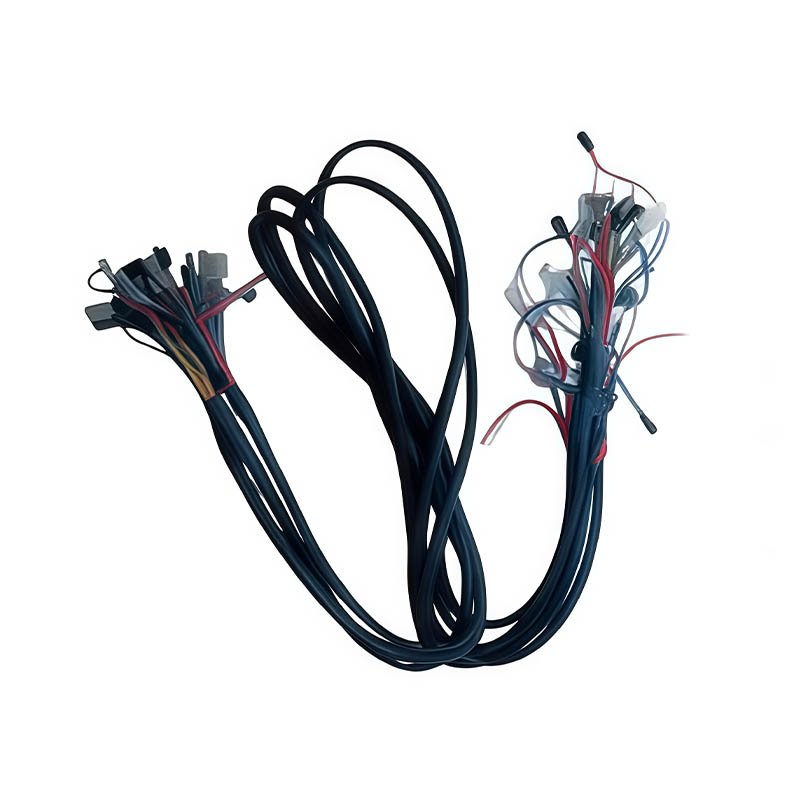
Structural design must balance mechanical strength and electrical performance. The motorcycle main cable should use a multi-core stranded structure to improve flexibility and reduce connection loosening due to vibration. Branch lines should be equipped with stress relief devices to prevent conductor breakage due to frequent bending. In high-temperature areas, such as near the engine, corrugated pipes or fiberglass sheaths should be used to protect the cable to prevent insulation aging. For lines near moving parts, sufficient slack should be provided to prevent increased contact resistance due to stretching.
Environmental management is a crucial aspect of preventing connection failures. In humid environments, waterproof sealant should be applied to the connection points to prevent moisture intrusion and degradation of insulation performance. In salt spray environments, nickel or zinc plating is required to enhance the corrosion resistance of the terminals. For high-temperature environments, heat insulation panels must be installed between the cable and high-temperature components to reduce the impact of heat radiation on the cable. Furthermore, contact between the cable and oil or chemical solvents must be avoided to prevent corrosion of the insulation layer.
Testing and verification are the last line of defense to ensure connection quality. After connection, a micro-ohmmeter must be used to measure the contact resistance, ensuring that its value does not exceed 1.5 times the resistance of a conductor of the same length. Insulation performance must be verified through a power frequency withstand voltage test to ensure no breakdown occurs under the specified voltage. Vibration tests are used to simulate actual riding conditions to check for loose connections. For critical circuits, thermal cycling tests are also required to verify their stability under temperature changes. All test data must be recorded in real time to create a traceable quality archive.
Maintenance is an effective means of extending the service life of the motorcycle main cable. Regularly check the cable sheath for damage; replace it promptly if cracks or signs of aging are found. Clean dust and oil from the connections to prevent increased contact resistance due to dirt buildup. Check for loose fasteners and ensure the cable layout is neat to prevent insulation damage due to friction. For vehicles parked for extended periods, start the engine periodically to prevent insulation degradation caused by prolonged inactivity.
Proper operating procedures are fundamental to preventing human-caused malfunctions. Maintenance personnel must be professionally trained and familiar with the structure and connection requirements of the main cable. When connecting wires, strictly follow the circuit diagram to avoid incorrect or missing connections. Use appropriate tools for stripping, crimping, and soldering to prevent damage to conductors or insulation due to improper handling. When working in high-temperature environments, wear protective gloves to avoid burns or cable damage. After maintenance, perform functional tests to ensure all electrical components are functioning correctly.